By Vaughn Cockayne (The Washington Times)
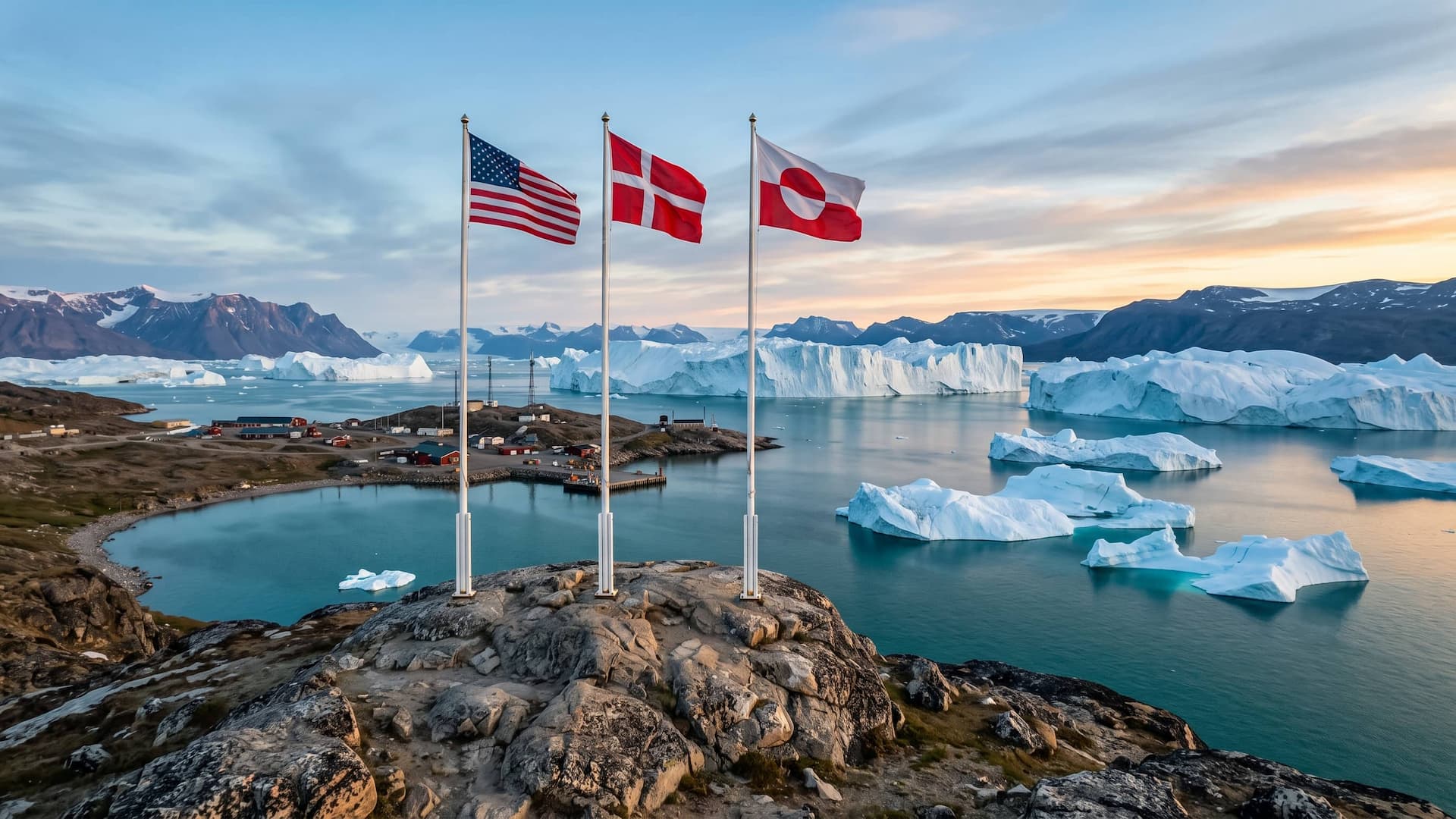
UNITED NATIONS — President Trump signed a trilateral agreement Tuesday with Denmark and Greenland that clears the way for a ramped-up U.S. military presence on the strategically important Arctic island.
The agreement follows months of tension between Washington, Copenhagen and Nuuk, the capital of Greenland, over control of the island.
At the signing ceremony on the sidelines of the United Nations General Assembly, Mr. Trump, flanked by Danish Prime Minister Mette Frederiksen and Greenland Prime Minister Jens-Frederik Nielsen, said the U.S. would continue to work in conjunction with the two countries.
“This is long in the making,” he said after the signing. “Many decades, probably centuries. You go back in the line of presidents, and almost every president at least mentioned it, but most just mentioned it.”
The agreement, which was publicized after the signing ceremony, states that the U.S. may maintain “defense areas” in the territories of Narsarsuaq in the southern part of Greenland and Mestersvig in the east.
The U.S. is also expected to extend contracts to Greenland-based companies for the construction and expansion of the defense areas.
The accord also calls for increased U.S. military access to the island, including in undersea areas.
The U.S. currently occupies one military base, the Pituffik Space Base, on Greenland’s northwestern coast.
Ms. Frederiksen emphasized that the deal expands a 1951 agreement between the U.S. and Denmark on Greenland’s security.
“In the kingdom of Denmark, the United States has a friend that has always kept our word. An ally you have always been able to rely on,” Ms. Frederiksen said. “Seventy-five years ago, we entered into an agreement about the defense of Greenland; today, we are signing a bigger and even better agreement. A deal that can last forever.”
She said the deal “underlines the importance of the NATO alliance” and that Denmark welcomes further partnerships with allies to prevent malign foreign influence in Greenland.
However, Ms. Frederiksen confirmed that the agreement preserves Greenland’s “territorial integrity” and right to “self-determination.”
Preserving territorial integrity and Greenland’s rights to its domestic resources were key priorities, Mr. Nielsen said after the signing.
“The world has changed since 1951. A notable change is Greenland itself at the table today signing this agreement,” Mr. Nielsen said. “And for Greenland, this is not only an agreement about us. It is an agreement with us. It takes into account the people of Greenland and our rights, our livelihood and the development of our country.”
Reaction in Europe to Mr. Trump’s repeated calls for the U.S. to acquire Greenland has shifted in recent months from outright condemnation to a cautious willingness to negotiate with the American president. Leaders across the continent have expressed support for an agreement that appears to preserve Danish and Greenlandic sovereignty.
Official reaction from European government and military officials framed the deal as a win for NATO defense against Russia and China while emphasizing that Greenland’s sovereignty, territorial integrity and right to self-determination remain untouched.
French President Emmanuel Macron said the deal served “to reaffirm Danish sovereignty.”
“I simply note that Danish sovereignty is respected, that international law is respected, and that this is what we were asking for. So it’s a good thing,” Mr. Macron said Saturday, a day after the preliminary announcement of the deal.
Danish lawmaker Henrik Dahl said Mr. Trump is taking credit for a deal that essentially preserves the status quo. “A wise Danish politician once said that you can achieve almost anything if you are willing to let others take the credit,” he said, according to the British media company UNILAD.
The deal was signed just days after Mr. Trump announced that his administration had reached an agreement to increase the U.S. military footprint on the Arctic island while keeping it under Denmark’s control.
Diplomats from the U.S., Greenland and Denmark reportedly worked behind the scenes for months to finalize a deal that would calm Nuuk’s fears of a hostile takeover and maintain Copenhagen’s control over the region.
Greenland, whose foreign and security policy has long been determined by Denmark, lies in a strategic location in the North Atlantic that some security officials and experts say could be vulnerable to incursions by Russia or China.
Melting sea ice and the development of advanced icebreakers have made it easier for both nations to navigate the Arctic in recent years, according to security analyses from the Center for Strategic and International Studies and the U.S. Naval War College.
The island nation is also rich in critical rare earth minerals used in advanced artificial intelligence chips, electric vehicles and precision missile guidance systems, according to reports from the U.S. Department of Defense and the critical minerals industry.
Although the agreement grants the U.S. expanded rights to defense infrastructure, the official text released after the ceremony confirms that control over domestic mining concessions remains under Greenlandic authority.
Mr. Trump has expressed interest in acquiring Greenland since his first term as president. After returning to the White House in 2025, he implied that he might authorize the use of military force to seize the island.
His remarks sparked outrage in Greenland, Denmark and across Europe. Although Greenland is not a NATO member, it is covered by the alliance through Denmark’s membership, and Mr. Trump’s aggressive rhetoric this year threatened the alliance’s stability.
This article was made available to WMAL via The Washington Times.