– The Washington Times
Dozens of members of Mexico’s national guard were killed and some U.S. citizens were stranded in Mexico in the violent, chaotic aftermath of a major military operation that left one of the world’s most powerful drug cartel leaders dead.
The U.S. provided intelligence support to the Mexican military for its operation Sunday that resulted in the death of Nemesio Ruben Oseguera Cervantes, known as “El Mencho,” the White House said. Trump administration officials celebrated the mission as an example of “unprecedented” cooperation between security agencies on both sides of the border.
For President Trump, the operation could offer some vindication that his tough rhetoric and cajoling of other leaders across the continent to take a harder line against drug trafficking is working.
Some analysts cautioned that the power vacuum created inside Oseguera Cervantes’ Jalisco New Generation Cartel could lead to even more instability as competing factions battle for control of the highly profitable outfit, which the U.S. says is responsible for much of the fentanyl and other narcotics flowing into the country.
The initial wave of violence after the cartel leader’s death left more than 70 people dead across Mexico. Mexican officials said at least 25 national guard members were killed, along with at least 30 suspected criminals, a prison guard and an agent from the state prosecutor’s office.
Mexican President Claudia Sheinbaum said Monday that her country had cleared the roadblocks set up by drug cartels and that order was being restored.
“You can rest assured that peace [is] being safeguarded,” she said at a press conference, according to English-language media accounts of her remarks.
Several key airports were closed Sunday after the operation, including those in Guadalajara and Puerto Vallarta. Flight cancellations and some road closures left tourists, including many Americans, unable to get home.
The State Department urged Americans in the country to shelter in place.
“Due to ongoing security operations and related road blockages and criminal activity, U.S. citizens in a number of locations in Mexico are urged to shelter in place,” the U.S. Embassy said in a statement.
White House press secretary Karoline Leavitt cast the operation as a joint success for Mexico and the U.S. She said it was proof that the Trump administration will use the full power of the U.S. government to stop the flow of drugs into the country.
“The United States provided intelligence support to the Mexican government in order to assist with an operation … in which Nemesio ‘El Mencho’ Oseguera Cervantes, an infamous drug lord and leader within the Jalisco New Generation Cartel, was eliminated,” she said in a post on X.
“Last year, President Trump rightfully designated the Jalisco New Generation Cartel as a Foreign Terrorist Organization — because that’s exactly what it is. In this operation, three additional cartel members were killed, three were wounded, and two were arrested,” she wrote. “President Trump has been very clear — the United States will ensure narcoterrorists sending deadly drugs to our homeland are forced to face the wrath of justice they have long deserved.”
What happens next?
The specifics of U.S. involvement in the operation weren’t immediately clear. U.S. intelligence agencies and the Pentagon have significant visibility into the operations of major drug cartels operating across the continent.
Since September, the U.S. has repeatedly targeted boats thought to be moving narcotics from Venezuela and other nations through the Caribbean and eastern Pacific into the U.S.
In January, U.S. Special Forces carried out a daring raid to capture Venezuelan President Nicolas Maduro in Caracas. He is awaiting trial in New York on federal charges related to narco-terrorism.
The Trump administration has pressured other governments in the region, including Mexico’s, to take a tougher stance against drug cartels. U.S. Ambassador Ron Johnson credited the Mexican military for doing just that. He said in a statement that bilateral relations between the U.S. and Mexico under Ms. Sheinbaum have “reached unprecedented levels.”
“The United States stands firmly with Mexico in this shared responsibility and effort,” he said.
Some specialists urged caution and warned that the death of its leader does not mean the cartel will become less dangerous.
“The killing of CJNG leader Nemesio Oseguera Cervantes marks a significant operational development for Mexican forces, but the reported immediate highway blockades and arson attacks show how quickly cartels can mobilize retaliation to demonstrate continued control,” said Sandra Pellegrini, a senior analyst for Latin America with the organization Armed Conflict Location & Event Data.
“Past cases suggest leadership removals rarely reduce violence long term, and instead often trigger instability as factions compete for power,” she wrote in comments circulated to reporters.
The cartel has at least 15,000 members, according to U.S. intelligence agencies, and generates billions of dollars annually. The group moves drugs all over the world, including to the U.S. and Canada, as well as Europe, Asia and Africa, the Office of the Director of National Intelligence said in a fact sheet.
The cartel’s financial and paramilitary power made its leader, Oseguera Cervantes, one of the most wanted criminals in North America. The U.S. had offered a $15 million reward for information leading to his capture.
He was wounded in the operation to capture him in Tapalpa, Jalisco, about a two-hour drive southwest of Guadalajara. He died while being flown to Mexico City, Mexican officials said.
The state is the base of the cartel, which is known for trafficking huge quantities of fentanyl and other drugs to the U.S.
Mexican officials indicated that they tracked the cartel leader through one of his romantic partners.
During the operation, troops came under fire and killed four people at the location. Three more people, including Oseguera Cervantes, were wounded and later died, the Mexican government said. Two others were arrested, and armored vehicles, rocket launchers and other arms were seized. Three members of the armed forces were wounded in that initial shootout.
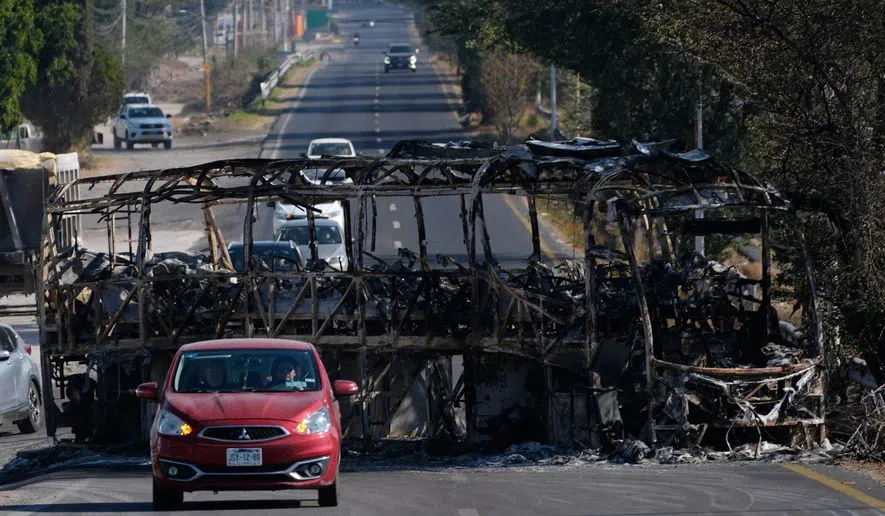
The death of Oseguera Cervantes sparked chaos in some parts of the country. Gunmen reportedly opened fire in some areas in the hours afterward. Cars burned out by cartel members blocked roads in 20 Mexican states and sent smoke billowing into the air.
People locked themselves in their homes in Guadalajara, Mexico’s second-largest city and Jalisco’s capital, and school was canceled Monday in several states as security forces were placed on alert across the country. Even Guatemala reinforced security on its border with Mexico.
Mexican authorities said early Monday that they had cleared most of the more than 250 cartel roadblocks.
• Ben Wolfgang can be reached at bwolfgang@washingtontimes.com.